Requirements for hydraulic balancing
What you need to clarify before reconciliation
- →Know the room area and heating load: Rule of thumb 50–70 W/m² (older buildings) or 25–40 W/m² (new buildings KfW 40)
- →Flowmeters are present on the manifold — without flowmeters, exact balancing is not possible
- →Known heating flow temperature: heat pump 30–45 °C, gas 45–60 °C
- →Heating circuits labeled and room allocation documented (which circuit = which room)
- →Heating is running and has reached operating temperature (min. 30 min warm-up before measurement)
Important warnings for reconciliation
The hydraulic balancing of underfloor heating systems has been legally mandated in Germany since GModG § 60 (formerly GEG § 60) for central heating systems. With integrated flow meters on the heating circuit distributor, it can be done as a DIY project in 2–3 hours — without external measuring equipment.
- Mandatory for: New installations, renovations with new heating, heat pump installation
- Proof required: Balancing log must be presentable upon request by authorities
- Without balancing: no eligibility for KfW-458 funding (HP heating)
- DIY balancing with flow meters is permitted — no specialized company strictly required
Calculate Flow Rate: The Formula
The target flow rate per heating circuit is derived from the heat load of the room:
V̇ = Volume flow, Q = Room heat load [W], c = 1.163 Wh/(kg·K), ρ = 1.0 kg/l, ΔT = Spread supply-return [K]
| Room Heat Load | Spread 5 K (HP) | Spread 8 K (Low Temp.) | Spread 10 K (Boiler) |
|---|---|---|---|
| 200 W (Bathroom ~4 m²) | 34 l/h | 22 l/h | 17 l/h |
| 400 W (Room ~10 m²) | 69 l/h | 43 l/h | 34 l/h |
| 600 W (Living Room ~15 m²) | 103 l/h | 75 l/h | 52 l/h |
| 800 W (Living Room ~20 m²) | 137 l/h | 100 l/h | 69 l/h |
| 1,000 W (Open Area) | 172 l/h | 125 l/h | 86 l/h |
Reading and Setting Flow Meters: Step-by-Step
per heating circuit
from target value
for complete balancing
Flow meters on the distributor directly display the current volume flow per circuit — no external measuring equipment is needed. Adjustment is made via the throttle handle at the top of the flow meter body:
- Set heating to normal operation (supply temperature should be present)
- Open all circuits completely (pull out throttle handle = open)
- Throttle each circuit to the calculated target flow rate
- Wait 30 minutes, recheck values (pump readjusts itself)
- Correct deviations > ±10%
- Log final values (circuit No., room designation, l/h value)
FBH Balancing vs. Radiator Balancing: The Differences
| Criterion | Underfloor Heating | Radiator System |
|---|---|---|
| Balancing Method | Flow meter at distributor | Thermostatic valve pre-setting |
| Measuring tool needed? | No — flow meter integrated | Yes — differential pressure gauge |
| Optimal spread | 5–10 K (depending on heat source) | 15–20 K |
| Controlled variable | Volume flow l/h per circuit | Differential pressure ΔP |
| DIY-suitable? | Yes, with flow meter distributor | Conditionally |
| GModG § 60 Proof | Protocol of flow values | Protocol of pre-setting values |
| Energy saving | 10–20 % vs. unbalanced system | 5–15 % |
- KfW funding 458 (July 2026): up to 80% subsidy for WP + FBH combination
- Hydraulic balancing is a funding prerequisite — no subsidy without proof
- DIY balancing with flow meter distributor saves 200–500 € in tradesman costs
- Energy saving: approx. 10–15 % heating energy compared to unbalanced systems
- →Step 1: Calculate the heating load for each room — Room area × Heating load W/m² = Heating power in W
- →Step 2: Calculate target flow rate — Formula: Q (l/h) = P (W) ÷ (ΔT × 1.163) — for ΔT 10 K and 1000 W = approx. 86 l/h = 1.43 l/min
- →Step 3: Identify the coldest / longest heating circuit — this reference circuit remains fully open
- →Step 4: Adjust all other dials on the flowmeter to the target value — Turn the adjustment ring until the float aligns with the target mark.
- →Step 5: Optimize pump delivery pressure — Set pump to the lowest level at which all circuits still achieve target flow
- →Step 6: After 24 hours of operation, check: Room temperatures even? All circuits warm? If necessary, fine adjustment
Costs: Hydraulic balancing DIY vs. professional
| Option | Costs / Savings |
|---|---|
| Retrofitted flowmeter — per circuit | approx. €15 |
| HVAC Engineer Balancing Protocol (Mandatory GEG § 60) | approx. €150–250 |
| Professional hydraulic balancing including report (6 circuits) | €300–500 |
| DIY balancing with integrated flow meters (time required) | approx. 2–3 hours, €0 extra cost |
| Heating cost savings through correct adjustment (annually) | 10–20% — with heating costs of €1,500, this is approximately €150–300 |
| Amortisation Professional Reconciliation (€300 with €200/year savings) | approx. 1.5 years |
Achtung – Fachmann empfohlen
Never open all circuits evenly—that's the opposite of hydraulic balancing. Long, large rooms need more flow than small rooms.
Achtung – Fachmann empfohlen
For heat pump systems: Excessive flow (> 3 l/min per circuit) reduces the COP. Target flow rate is 0.5–2 l/min for optimal efficiency.
Frequent questions about hydraulic balancing
Stainless steel manifold with integrated flow meters
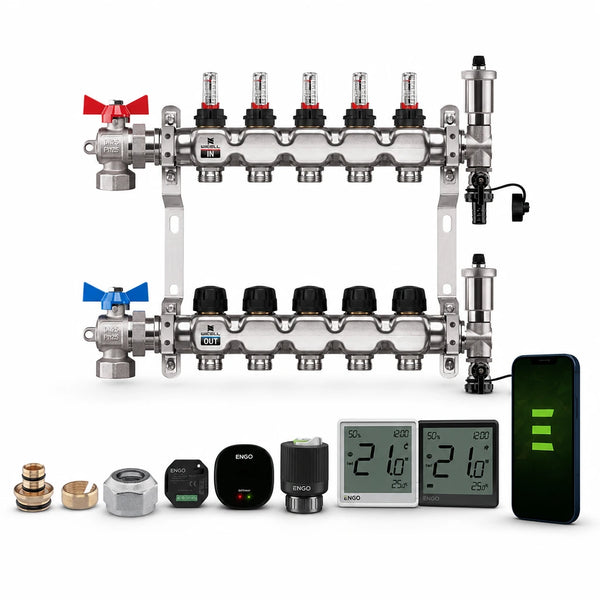
Configurable Heating Circuit Manifold Set | Underfloor Heating Set Discount
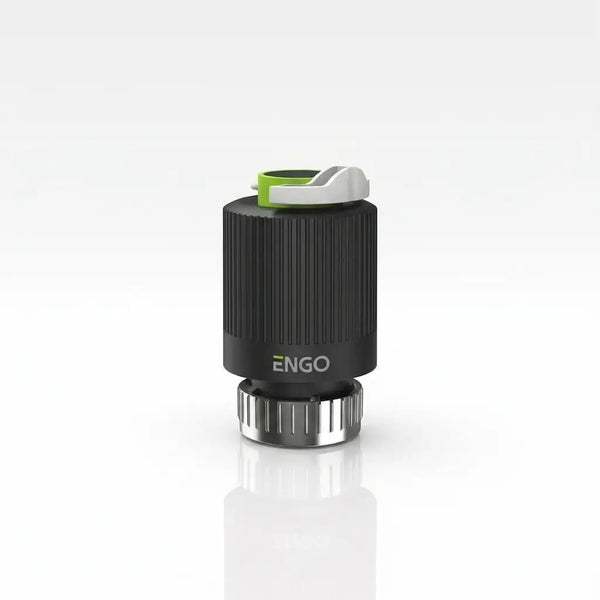
Thermoelectric actuator Engo E30NC-230 for underfloor heating
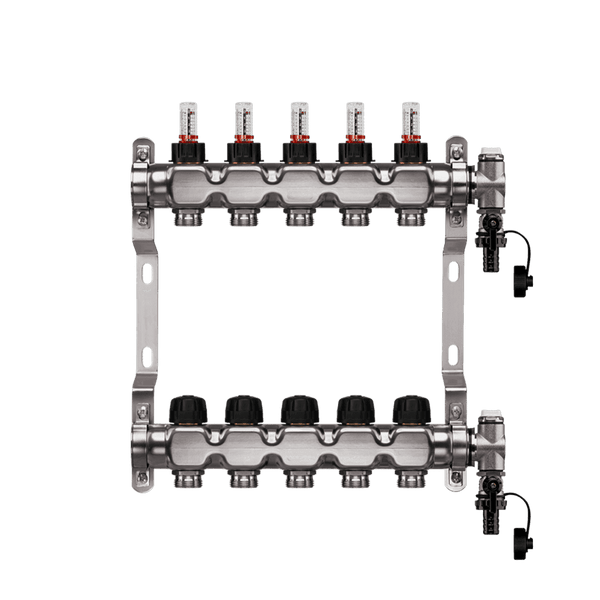
Heating circuit manifold with top meter