
Verifiziert
Immer jemand zu erreichen. Dünnschicht-Set ließ sich leicht verlegen und funktioniert einwandfrei.
 Low-Profile Underfloor Heating Complete Set | Configure your set!
The MC Therm thin-layer underfloor heating system brings even warmth to any old building – with a total installation height from 18 mm, directly on tiles or screed. Self-adhesive studded membrane or MC KLETT fleece, ready for covering in hours with Planogel Rheo.
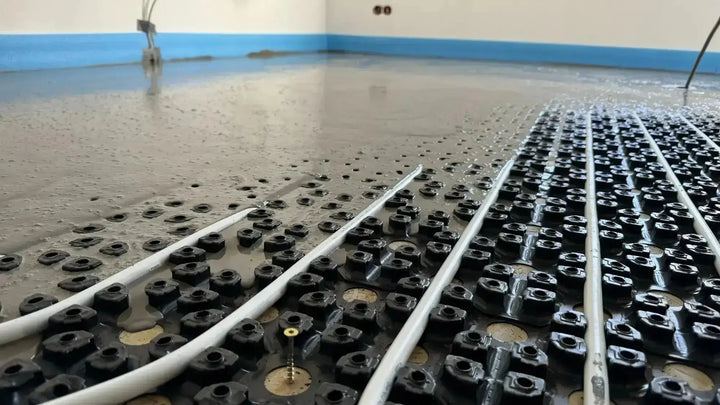
Das Dünnschichtsystem ist eine Fußbodenheizung mit minimaler Aufbauhöhe, die direkt auf dem bestehenden Boden verlegt wird – mit dünnem Planogel Rheo Estrich statt klassischem Nassestrich.
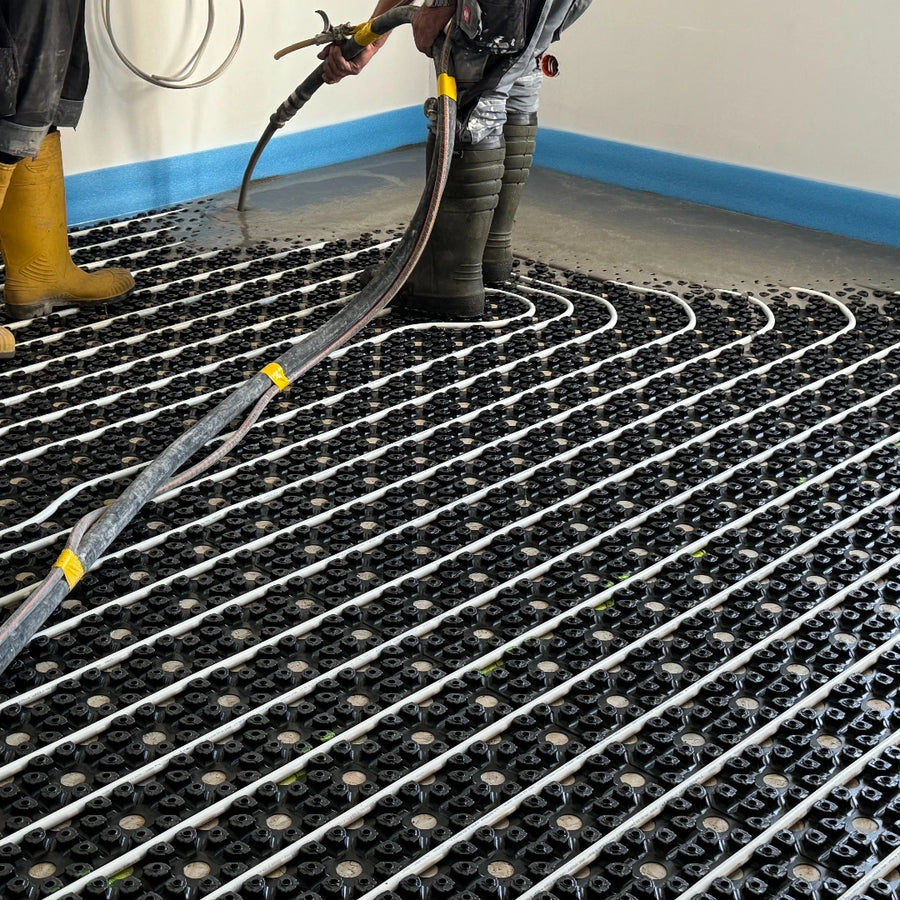
Das Dünnschichtsystem von MC Therm besteht aus einer selbstklebenden Noppenfolie oder einem nur 2 mm dünnen, gelochten Klettvlies. Darauf werden die Heizrohre verlegt und anschließend mit einem speziellen Calciumsulfat-Estrich (CAF) – der Nivelliermasse Planogel Rheo von Kerakoll – mit nur 5 mm Rohrüberdeckung vergossen.
Durch die Perforation der Unterlage verbindet sich der Estrich direkt mit dem Untergrund und bildet eine stabile Haftungsbrücke. Das Ergebnis: eine vollwertige Flächenheizung, die kaum aufträgt und Räume gleichmäßig erwärmt.
Überall dort, wo jeder Millimeter zählt: Altbau-Sanierung, Renovierung, Bad-Umbau, Dachgeschossausbau und Modernisierungen, bei denen ein klassischer Nassestrich die Türen, Treppen und Anschlusshöhen sprengen würde. Auch auf Holzbalkendecken, die kein hohes Estrichgewicht tragen, ist das leichte Dünnschichtsystem ideal.
Ob Eigentümer, Heimwerker oder Fachbetrieb – das Dünnschichtsystem ist die richtige Wahl, wenn niedrige Aufbauhöhe und schnelle Verlegung entscheidend sind.
Du willst eine Fußbodenheizung nachrüsten, ohne Türen zu kürzen oder den Estrich aufzustemmen.
Aufkleben, Rohr eindrücken, fertig – die Noppenfolie und das Klettvlies sind ideal für die Eigenmontage.
Du brauchst ein bewährtes System mit kurzer Trocknungszeit und sauberer Baustellenlogistik.
Wähle deine Systemvariante – zwei Möglichkeiten, beide ab 17–18 mm Gesamtaufbauhöhe. Klicke auf eine Schicht, um Details zu sehen.
With Planogel Rheo (Kerakoll) as a leveling compound, the thin-layer system is ready for covering in just a few hours – instead of the usual 21–28 days for conventional wet screed.
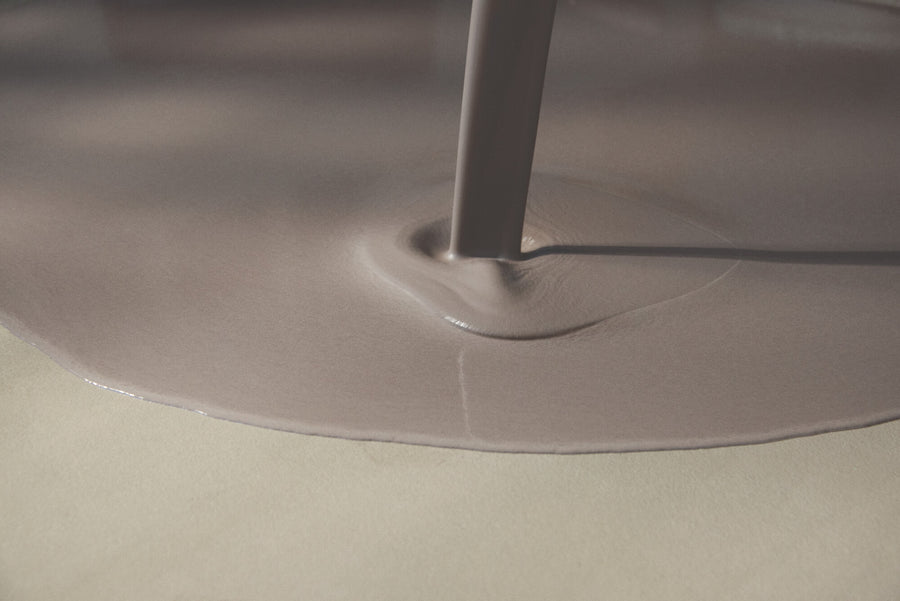
* At +23 °C, 50% relative humidity. Source: Kerakoll technical data sheet 2022 (EN 13813 CT C30-F7).
Ehrlich abgewogen: Das Dünnschichtsystem spielt seine Stärken vor allem im Bestand aus – ein paar Dinge solltest du trotzdem wissen.
Neubau, Sanierung oder Holzbalkendecke – MC Therm hat für jede Aufbauhöhe das passende System. Hier die vier Familien im direkten Vergleich.
Selbstklebende Noppenfolie oder Klettvlies. Planogel Rheo Estrich – in Stunden belegreif.
Heizrohr ins Klettvlies drücken – freier Rohrabstand, werkzeuglose 1-Mann-Montage.
Heizrohr in Trockenestrich-Elementen. Kein Nassestrich, sofort begehbar.
Der Klassiker: Rohr auf Noppenplatte tackern, mit Estrich vergießen. Bewährt & preiswert.
| System | Aufbauhöhe | Kosten | Estrich | Ideal für |
|---|---|---|---|---|
Dünnschichtdieser RatgeberNoppenfolie / Klett |
ab 18 mm | ab 15 €/m² | Planogel Rheo (dünn) | Altbau, Sanierung, Bad |
KlettsystemMC Klett Slim / Silent |
ab 25 mm | ab 14 €/m² | Nassestrich | Neubau & Renovierung |
TrockenbauTrockenestrich-Element |
ab 45 mm | ab 31 €/m² | kein Nassestrich | Holzbalkendecke |
TackersystemNoppenplatte |
ab 65 mm | ab 8 €/m² | Nassestrich | Neubau |
Most projects work fine with 14mm, but as soon as circuit length, room size, or a heat pump come into play, the 16mm pipe pays off.
The 16mm PE-RT EVOH heating pipe allows circuit lengths of up to approx. 100 m – compared to ~80 m for the 14mm pipe. This sounds technical, but it has a direct practical consequence: in rooms larger than 20 m², a single heating circuit can be laid with 16mm instead of two. Fewer heating circuits mean fewer manifold connections, fewer actuators, and simpler hydraulic balancing.
The second reason is pressure loss. The 16mm pipe has approx. 30% less pressure loss than the 14mm pipe at the same volume flow. This reduces the load on the heating circuit pump – particularly relevant for heat pumps that operate with low flow temperatures (35–45 °C). Low flow temperature + uniform volume flow = higher COP and lower operating costs.
For bathrooms, small rooms, and hallways under 15 m², the 14mm pipe is the right choice: lower material costs, lower installation height (approx. 20 mm instead of 22 mm), and the shorter circuit length is not a disadvantage here.
| Eigenschaft | 14mm-Rohr | 16mm-Rohr |
|---|---|---|
| Max. Kreislänge | ~80 m | ~100 m |
| Druckverlust | höher | ca. 30 % niedriger |
| Passende Noppenfolie | NP 14 | NP 16 |
| Aufbauhöhe Nassbau | ca. 20 mm | ca. 22 mm |
| Empf. Raumgröße/Kreis | bis ~15 m² | bis ~25 m² |
| Ideal für | Bad, kleine Räume | Wohnraum, WP-Betrieb |
Important: The 16mm pipe absolutely requires the matching NerthusFlow dimpled sheet for 16mm pipe. The dimple geometry is matched to the pipe diameter – the 14mm sheet will not securely hold the 16mm pipe. MC Therm offers both variants individually and as part of the complete set.
Tiefer einsteigen: Diese Ratgeber begleiten dich von der Planung bis zum fertig verlegten Boden.
Thin Film System Costs 2026 – Current Prices & Calculation
Jetzt lesen → InstructionsInstalling a Thin-Layer System – Step-by-Step Installation Guide
Jetzt lesen → PlanningPlanning a thin-layer system: Calculating pipe quantity & heating circuits
Jetzt lesen → RefurbishmentRetrofitting underfloor heating in old buildings – costs, variants & planning
Jetzt lesen →Dank selbstklebender Rückseite lässt sich das System auf nahezu jedem Untergrund verlegen. Hier die wichtigsten Einsatzfälle – und wo ein anderes System die bessere Wahl ist.
Als Komplettset startet das Dünnschichtsystem bei ca. 25 €/m² für Noppenfolie, Heizrohr und Randdämmstreifen exkl. Planogel Rheo Estrich. Mit Nivelliermasse liegt das Gesamtsystem bei rund 65 €/m².
Die tatsächlichen Kosten hängen von wenigen Faktoren ab:
Als Direkthersteller (OEM seit 1996) liefert MC Therm ohne Zwischenhändler – das macht das Dünnschichtsystem trotz Premium-Estrich preislich attraktiv. Komplettsets sind 3–10 % günstiger als der Einzelkauf.
Aufeinander abgestimmte Komponenten, fertig konfiguriert für deine Fläche – damit beim Verlegen nichts fehlt.
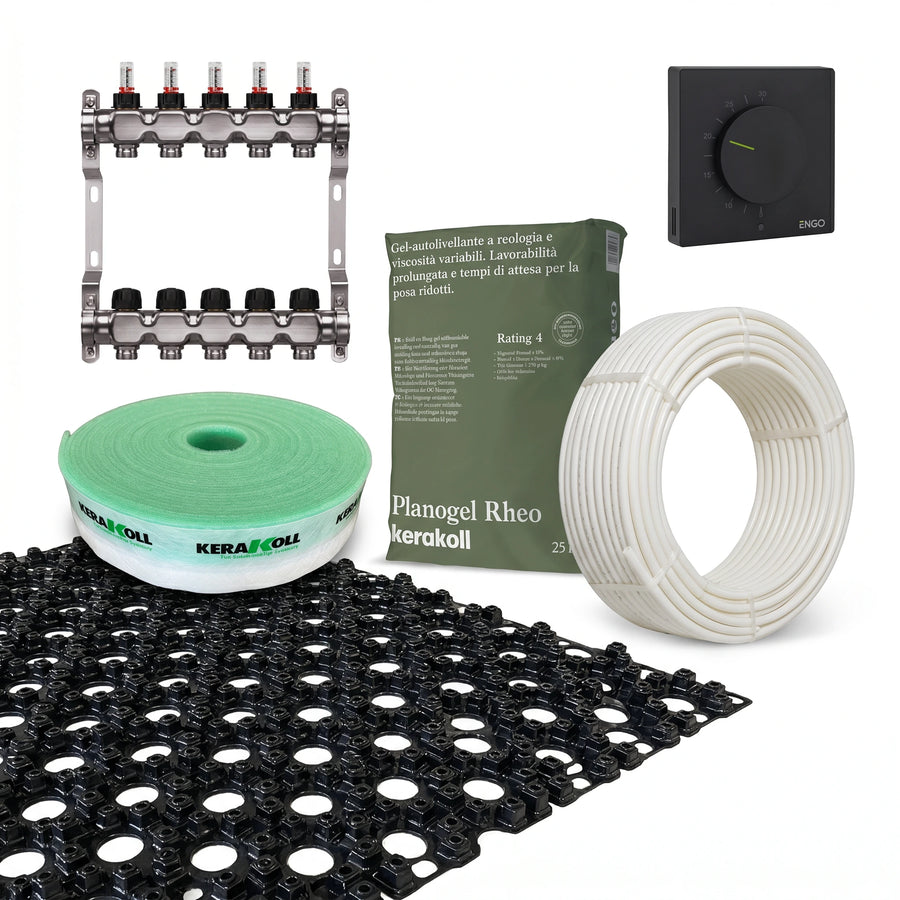
Stelle deine Fläche und das Rohr ein – du erhältst sofort einen unverbindlichen Richtwert inklusive Komplettset-Rabatt.
Unverbindlicher Richtwert. Endpreis abhängig von Konfiguration, Verteiler, Steuerung und Verschnitt. Verteiler & Regeltechnik sind nicht enthalten.
MC-Therm-Systeme sind auf die einschlägigen Normen für Flächenheizungen ausgelegt und arbeiten effizient mit modernen Wärmeerzeugern zusammen.
Auslegung, Wärmeleistung und Prüfung wassergeführter Fußbodenheizungen – die maßgebende europäische Norm.
Für erhöhte Anforderungen bietet MC Therm das Klettvlies MC KLETT Silent mit 28 dB Trittschallminderung.
Geringe Vorlauftemperaturen (25–55 °C) machen das Dünnschichtsystem ideal für Wärmepumpe und Brennwerttechnik.
Die wichtigsten Antworten rund um das Dünnschichtsystem. Du hast eine andere Frage? Schreib uns an shop@mc-therm.de.
A thin-layer system is a radiant floor heating system with a particularly low installation height – in contrast to classic wet screed (65–80 mm), a total build-up of 17–30 mm is sufficient here. The system consists of a self-adhesive studded foil or a hook-and-loop fleece, PE-RT heating pipes (Ø 12–16 mm), and a fast-curing special screed (Planogel Rheo). It is particularly suitable for old buildings where the existing floor structure is to be preserved and doors or window sills cannot be adapted.
The total build-up is calculated depending on the variant:
Wet System (Dimpled Sheet NP12): 10 mm sheet + 12 mm pipe + 5 mm screed above pipe = 17 mm total
Wet System (Dimpled Sheet NP16): 14 mm sheet + 16 mm pipe + 5 mm screed = 22 mm total
Dry System (ArdusAlu): 22–30 mm without wet screed
For comparison: Traditional wet screed is 65–80 mm. The thin-layer system is the ideal solution if door undercuts are limited or the existing floor is to be preserved.
MC Therm thin-layer system complete sets start at approx. €15/m² for dimpled sheets and heating pipes. The complete set, including dimpled sheets, pipes, edge insulation strips, and connection set, costs €20–35/m² depending on the pipe diameter and spacing. Additionally, there is Planogel Rheo special screed (approx. €30–40/m²). Total material costs, including screed, are typically €50–75/m² – significantly cheaper than a renovation involving breaking up the old floor. → Detailed Cost Overview 2026
Yes – the thin-layer system is well-suited for experienced DIY enthusiasts. The studded mat is self-adhesive, and the heating pipe simply clips in. The most challenging part is the correct application of the Planogel Rheo screed (pay attention to the mixing ratio, ensure uniform thickness). Important: Pressure test (4 bar, 24 h) BEFORE the screed. If you are unsure: MC Therm offers free planning advice including quantity calculation. → Step-by-step installation guide
NerthusFlow Dimpled Sheet: Structured PE film with dimples, into which the heating pipe is directly clipped. Self-adhesive underside - stick directly onto screed or tiles. Variants NP12, NP14, NP16 for pipe diameters 12–16 mm. Installation height: 10–16 mm. No clips required.
MC KLETT Fleece: Flat support fleece with hook-and-loop structure, onto which the pipe is simply pressed. Installation height only 5–6 mm – even flatter than dimpled sheets, ideal when every millimeter counts. Both are compatible with Planogel Rheo or traditional anhydrite screed.
Yes – the thin-layer system and heat pump are the optimal combination. Underfloor heating systems operate with flow temperatures of 30–40 °C, at which heat pumps achieve their best efficiency (COP 4–5). Traditional radiators require 65–75 °C – where heat pumps operate inefficiently (COP 2–3). Those who combine their heat pump with the thin-layer system typically reduce heating costs by 30–50% compared to a gas radiator system.
The 16mm heating pipe is recommended if any of these conditions apply: circuit length over 80 m, room area over 20–25 m² per heating circuit, or in combination with a heat pump. The 16mm pipe has ~30% less pressure loss, allows circuit lengths up to 100 m, and improves the heat pump's COP through more uniform flow.
For the 16mm PE-RT EVOH heating pipe, the NerthusFlow knobbed sheet for 16mm pipe (NP16) is required. The knob geometry is adapted to the pipe diameter. Wet construction height: approx. 22 mm total. The 14mm film does not hold the 16mm pipe securely.
Konfiguriere dein Set aus Noppenfolie oder Klettvlies, Heizrohr und Randdämmstreifen – fertig abgestimmt für deine Fläche, direkt vom Hersteller.


