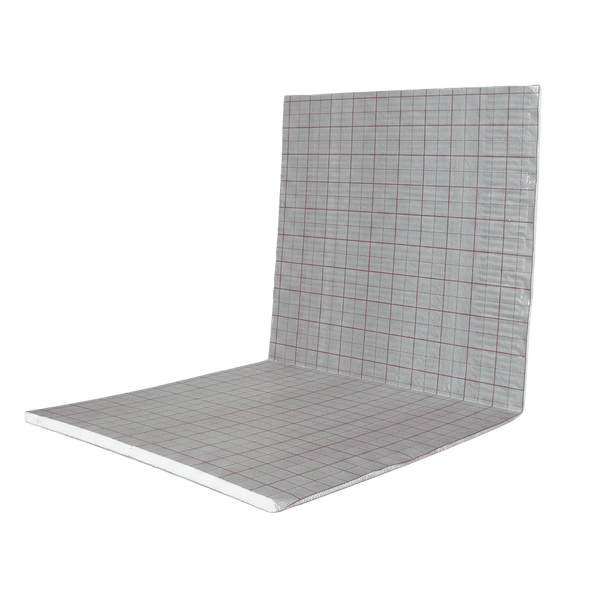
Available insulation boards for the staple system
Insulation Boards at a Glance
- →EPS Folded Slab WLG 045 — λ = 0.045 W/mK, compressive strength 4,000 kPa
- →EPS folding board WLG 040 — λ = 0.040 W/mK, compressive strength 5,000 kPa
- →EPS Foldable Panel WLG 035 — λ = 0.035 W/mK, compressive strength 10,000 kPa
- →Mineral wool insulation board WLG 040 — λ = 0.040 W/mK, vapor-permeable
- →Hollow-chamber laying panel PP — λ = 0.040 W/mK, integrated tacker system
What you need to clarify before the election
- →Clarify usage type: living space, commercial, wet room — determines compressive strength and moisture resistance
- →Check sound insulation requirements: Multi-family houses often require mineral wool according to DIN 4109
- →Determine available installation height: influences the choice between WLG 035 and 040
- →Check Norman requirements according to GEG and DIN EN 1264 for R-value
Why the Choice of Insulation Board Is Important
Insulation board variants in comparison
EPS vs. Mineral Wool: Fundamental Difference: EPS (expanded polystyrene) and mineral wool differ in four key properties: thermal conductivity, compressive strength, moisture resistance, and sound insulation. EPS is compression-resistant, moisture-resistant, and inexpensive—ideal as a base for wet cement screed. Mineral wool is diffusion-open and offers better impact sound insulation, but is more moisture-sensitive and requires careful installation. EPS is standard for the tacker system because the wet screed process requires moisture resistance.
EPS WLG 045: Entry-level, economical, for light loads: EPS WLG 045 has a thermal conductivity of 0.045 W/mK—the weakest of the three classes. Compressive strength: 4,000 kPa. This is sufficient for living spaces with normal live loads (max. 2 kN/m²). The disadvantage: For R = 1.25 m²K/W (GEG new construction above cellar), 56 mm are required—6 mm more than for WLG 040. Price: from 2.56 €/m². Application: older renovations, well-insulated floors, when build-up height is not an issue.
EPS WLG 040: Standard for New Construction and Renovation: EPS WLG 040 is the most commonly used tacker system board. Thermal conductivity: 0.040 W/mK. Compressive strength: 5,000 kPa. For R = 1.25 m²K/W, 50 mm are required. The rolled-out variant (WLG 040) is suitable for large areas without many cuts. Price: from €2.43/m². Application: all standard applications in residential construction, new builds over basements and ground, commercial areas with normal loads.
EPS WLG 035: Best Insulation, Highest Compressive Strength: EPS WLG 035 offers the best thermal insulation performance among EPS variants: λ = 0.035 W/mK. Compressive strength: 10,000 kPa — twice as high as WLG 040. For R = 1.25 m²K/W, a theoretical thickness of 44 mm is sufficient. In practice, 45–50 mm are used. Application: when construction height is limited, when high compressive loads occur (commercial), or when particularly efficient insulation is desired. Price: from €3.44/m² — approx. 40% more expensive than WLG 040.
Mineral Wool WLG 040: When it makes sense: Mineral wool WLG 040 (λ = 0.040 W/mK) is the first choice when sound insulation according to DIN 4109 is required – typically in multi-family homes. The impact sound insulation value is better than with EPS, as the fibers absorb structure-borne noise more strongly. Disadvantage: Mineral wool is sensitive to moisture and must be particularly protected during screed work. It is more expensive than EPS and is less frequently used as a tacker system underlay. Recommendation: only for documented sound insulation requirements.
Twin-wall laying board PP: Combi-system without grid film: The polypropylene (PP) hollow chamber installation panel combines insulation and an installation profile in one component: The heating pipe is pressed directly into the hollow chambers — no separate grid film is necessary. Thermal conductivity: λ = 0.040 W/mK. The panel is moisture-resistant, dimensionally stable, and suitable for demanding projects. Price: from €8.52/m² — significantly more expensive than EPS, but without film and with faster installation. Application: Renovation with limited space, higher-end projects where precise pipe positioning is desired.
Frequently Asked Questions About Choosing Insulation Boards
Insulation panels for the tacker system
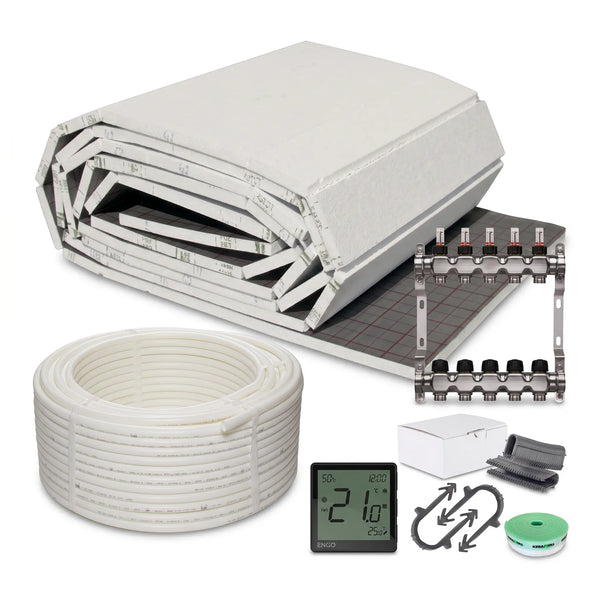
Tacker System Underfloor Heating Complete Set | Configure & Buy Now
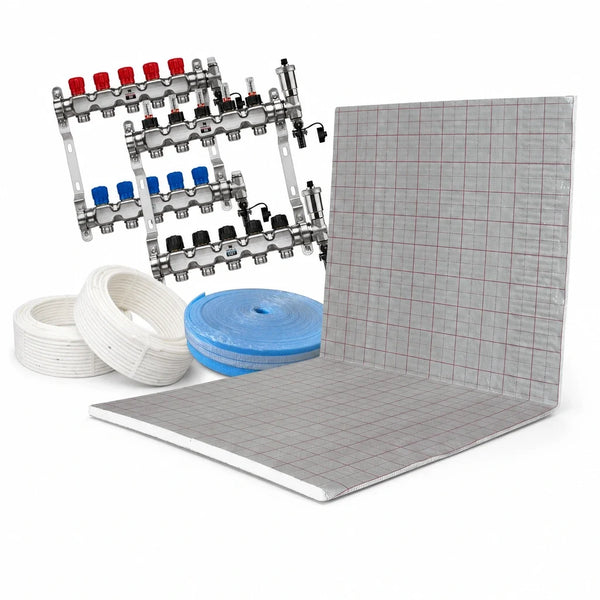
Tacker System Underfloor Heating Complete Set 100 m²
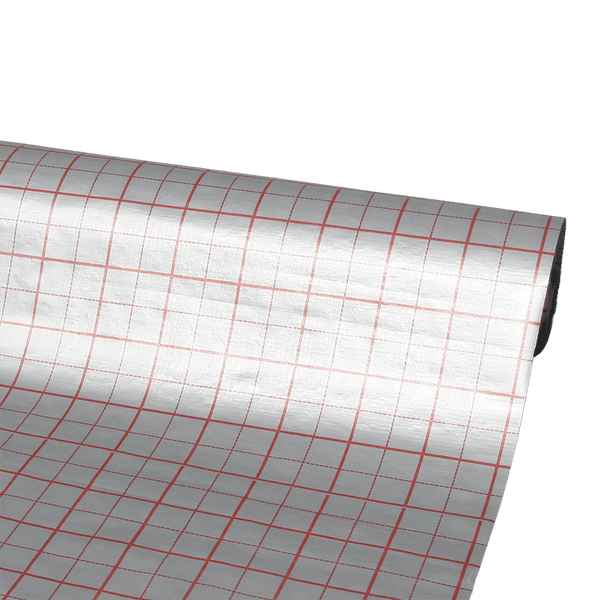
Grid foil for underfloor heating with ribbon fabric – sold by the meter