What you should clarify before comparing materials
Checklist: Answer these questions first
- →Specify installation system: Tack/Velcro (16 x 2 mm), clamping rail (16 or 17 x 2 mm), wet screed (16–20 x 2 mm)
- →Clarify flow temperature: heat pump 30–45 °C, gas heating 45–60 °C, old buildings up to 70 °C
- →Estimate circuit length: up to 80 m → 16 × 2 mm sufficient; over 100 m → 17 × 2 mm or multi-layer composite pipe
- →Check tightest bending radii in installation plan: PE-Xa more flexible, PE-RT stiffer than PE-Xa at cold temperatures
- →Budget: PE-RT cheapest option, PE-Xa & multi-layer composite pipe approx. 30–45% surcharge
The Three Pipe Types in Detail
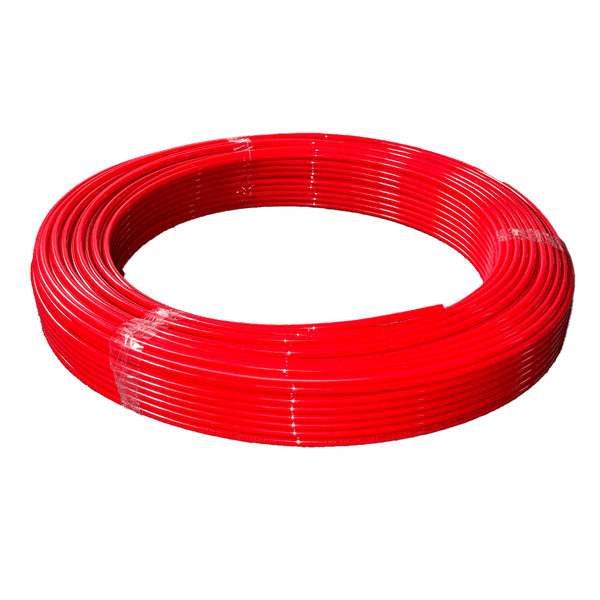
PE-RT EVOH: The workhorse of underfloor heating. Non-crosslinked, thermoplastic, easy to install. Continuous temperature 70 °C (Type I) or 90 °C (Type II), 10 bar operating pressure, EVOH oxygen barrier layer according to DIN 4726. Internal roughness ~7 µm for optimal flow. Standard: EN ISO 22391.
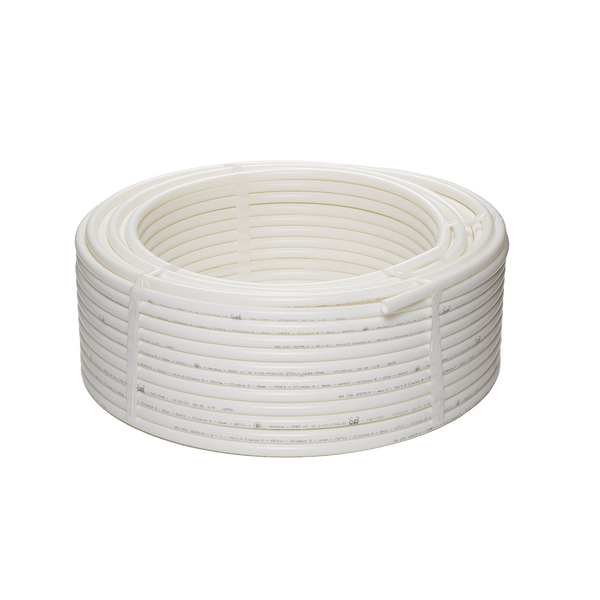
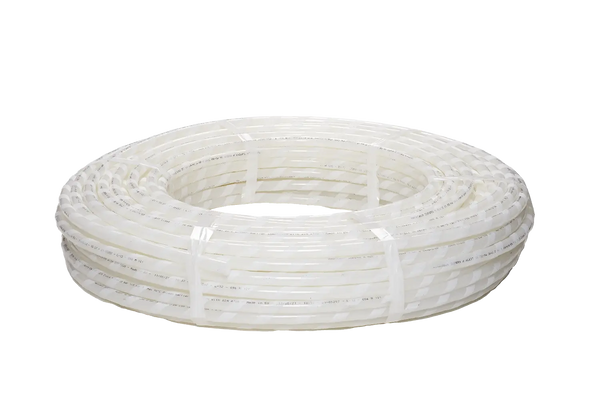
PE-Xa EVOH: Crosslinked according to the Engel process – stable crosslinking in the polymer increases creep resistance and continuous temperature resistance to 95 °C (110 °C short-term). Slightly stiffer than PE-RT, but with better shape memory. Ideal for dry construction, renovation, and tight bending radii. Standard: EN ISO 15875.
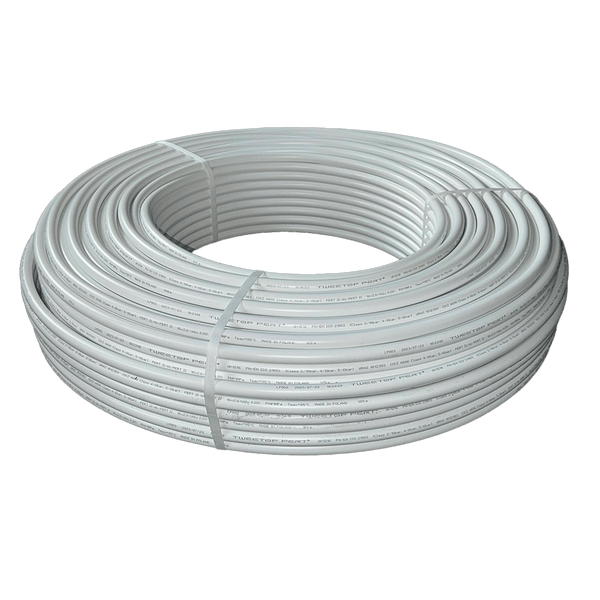
PE-RT-ALU-PE: Five layers, two functions. The ALU layer blocks oxygen more reliably than EVOH and gives the pipe dimensional stability – it holds its position after bending. Thermal expansion 0.025 mm/m·K (vs. 0.14 for PE). SKZ and DVGW certified. Standard: DIN EN ISO 21003.
Material Comparison: Prices & Characteristics 2026
| Property / Type | Value |
|---|---|
| PE-RT EVOH 16 x 2 mm (200 m roll) | from €0.48/m |
| PE-RT EVOH 16 × 2 mm (600 m roll) | cheaper — bulk discount |
| PE-Xa EVOH 16 × 2 mm (200 m coil) | from €0.66/m |
| PE-Xa EVOH 17 × 2 mm (200 m / 600 m) | from €0.66/m |
| PE-RT-ALU-PE Multilayer Composite Pipe 16 x 2 mm | from €0.70/m |
| Surcharge PEXa vs. PERT (100 m) | +€18 — for 100m circle |
| Additional charge for multi-layer composite pipe vs. PE-RT (100 m) | +€22 — for 100 m circle |
| PE-RT: max. continuous operating temperature | 70 °C (Type I) / 90 °C (Type II) |
| PE-Xa: max. continuous operating temperature | 95 °C |
| Multilayer composite pipe: Thermal expansion | 0.025 mm/m·K — 6× less than PE |
| PE-RT / PE-Xa: Thermal Expansion | 0.14 mm/m·K — Provide for expansion joints |
| Minimum bending radius (all types) | 5 × Outside diameter (16 mm → 80 mm) |
Frequent Questions: PE-RT vs. PE-Xa vs. Multilayer Composite Pipe
PE-RT (polyethylene of raised temperature resistance) is a non-cross-linked polymer – the chains are linear, the pipe remains thermoplastic, and is easy to bend and cold-process. Price: from €0.48/m. PE-Xa (peroxide-cross-linked according to the Engel method) has covalent cross-links between the polymer chains – resulting in higher long-term temperature resistance (95 °C vs. 70 °C), higher creep behavior under load, and shape memory after deformation. Price: from €0.66/m. For heat pumps with a flow temperature of 30–45 °C, both are equally good – the difference only becomes apparent at flow temperatures > 70 °C.
The multi-layer composite pipe consists of five layers: PE-RT (inner) – adhesive – aluminum – adhesive – PE-RT (outer). The aluminum layer serves two functions: 1. Oxygen barrier (≤ 0.1 mg/m²·d·bar according to DIN 4726) – no EVOH needed. 2. Dimensional stability after bending – the pipe maintains its shape, no spring-back like with PE. The most important advantage: thermal expansion is only 0.025 mm/m·K instead of 0.14 mm/m·K for PE. For 600 m of pipe in a system with a 40 K temperature spread, this means: PE expands by 3.36 m, while the multi-layer composite pipe expands by only 0.60 m. SKZ and DVGW certified. Recommendation: very long circuits (> 80 m), dimensionally stable installation without staple plates, high demands on dimensional accuracy.
All three types are suitable for heat pumps. For most heat pump systems with a flow temperature of 30–40 °C, PE-RT EVOH is the most economical choice. For long circuits > 80 m and heat pumps that rely on precise hydraulics, the multi-layer composite pipe is recommended – the lower thermal expansion reduces stress in the screed. PE-Xa is the best choice for dry construction systems with tight bending radii or if the heat pump occasionally switches to higher flow temperatures (> 55 °C).
Yes – in different heating circuits within the same building. For example: PE-RT 16 × 2 mm for living rooms with a simple laying distance of 15 cm, PE-Xa 16 × 2 mm for the bathroom with a tight bending radius. Hydraulic balancing at the manifold compensates for different pressure losses. However, always use only one pipe type within a heating circuit – different coefficients of thermal expansion could otherwise create stresses.
EN ISO 22391: Standard for PE-RT pipes (hot/cold water) – regulates material classes, wall thickness tolerances and pressure resistance. EN ISO 15875: Standard for PE-Xa pipes – additionally tests the degree of cross-linking (≥ 70%) and creep resistance under sustained load. DIN EN ISO 21003: Standard for multi-layer composite pipes PE/ALU/PE – regulates the bond strength between plastic and aluminium as well as long-term pressure resistance at 95 °C. All these standards apply in addition to DIN 4726 Oxygen Tightness, which applies to all heating pipes regardless of the material.
The minimum bending radius is 5 × outer diameter for all pipe types: 16 mm → min. 80 mm, 17 mm → min. 85 mm, 20 mm → min. 100 mm. PEX-a and multi-layer composite pipes better maintain the radius after bending – PE-RT springs back slightly and must be secured with staples or in system panels. A bending radius that is too small (< 5 × OD) will kink the pipe and permanently reduce the cross-section.